

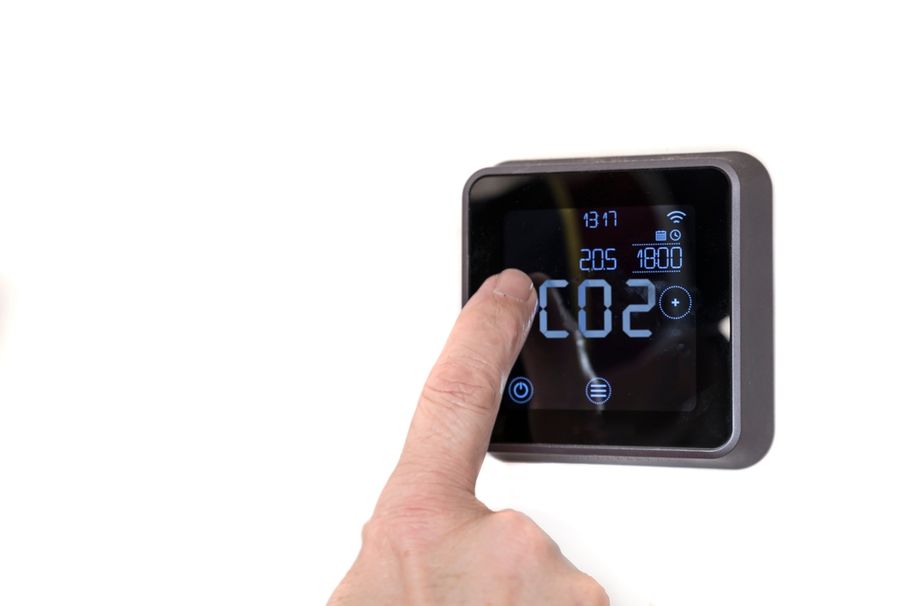
Carbon dioxide can build up indoors when occupied rooms do not receive enough fresh air, making a CO₂ monitor a useful tool for spotting ventilation patterns. Unlike a smoke or carbon-monoxide alarm, these devices track environmental conditions rather than emergency combustion hazards. Some focus almost entirely on CO₂, while others also measure particles, humidity, temperature, radon, or volatile organic compounds. The right monitor can turn invisible air-quality changes into clear, actionable information you can use every day.
Aranet4 HOME Keeps CO₂ Monitoring Focused
The Aranet4 HOME centers its design on carbon-dioxide monitoring. It uses an NDIR sensor, measures CO₂ from 0 to 9,999 ppm, and also tracks temperature, relative humidity, and atmospheric pressure. An E-Ink display provides readings directly on the device, while the Aranet Home app can show trends, alerts, and historical measurements.
Its battery-powered design is particularly useful for moving between a bedroom, home office, classroom, or other occupied space. Battery life is rated at up to four years, and the device does not require a subscription. Because its feature set stays relatively narrow, it suits someone primarily interested in understanding when a room becomes stuffy and how ventilation changes affect CO₂ over time.
Airthings View Plus Tracks a Wider Air-Quality Picture
The Airthings View Plus measures seven factors: CO₂, PM2.5, radon, VOCs, temperature, humidity, and air pressure. Its CO₂ sensor uses NDIR technology with a measurement range of 400 to 5,000 ppm. The front ePaper display can show selected readings, while a color indicator provides an at-a-glance status signal.
Wi-Fi connectivity allows readings to reach the accompanying app, and the unit can operate from batteries or USB-C power. Battery life is rated at up to two years, depending on settings and the Wi-Fi environment. This broader sensor package makes the View Plus useful when CO₂ is only one concern. A household dealing with wildfire smoke, humidity changes, or radon can monitor several conditions from one device rather than maintaining separate instruments.
Awair Element Combines Five Everyday Measurements
The Awair Element monitors CO₂, PM2.5, VOCs, temperature, and humidity. Its specified CO₂ measurement range runs from 400 to 5,000 ppm, while the PM2.5 sensor covers 0 to 1,000 micrograms per cubic meter.
Readings are available directly on the device, and the accompanying app provides remote access, air-quality scores, notifications, and changes over time. The Element connects over 2.4-GHz Wi-Fi and uses an external power adapter rather than relying on long-term battery operation. That arrangement suits a fixed monitoring location such as a home office, living room, or bedroom where continuous power is readily available.
The inclusion of particle and VOC measurements also provides context that CO₂ alone cannot supply. Opening a window may improve a ventilation-related CO₂ reading, for example, while a separate particle reading can reveal that outdoor conditions are affecting indoor air at the same time.
Qingping Air Monitor Lite Adds PM10 Tracking
The Qingping Air Monitor Lite measures five conditions: CO₂, PM2.5, PM10, temperature, and humidity. Its CO₂ range extends from 400 to 9,999 ppm, while both particle measurements cover 0 to 500 micrograms per cubic meter. A touch bar lets users switch among measurements on the device display, and the five readings refresh every second.
The monitor contains a 2,000-mAh rechargeable battery, uses USB-C for power, and is listed for approximately seven hours of battery operation. It also supports Wi-Fi, Bluetooth, Apple Home, and Mi Home functions. Its compact design works well for someone who wants particle measurements alongside CO₂ without moving into a larger multi-sensor monitor.
Use CO₂ as a Ventilation Clue
Indoor CO₂ readings can provide useful information about ventilation, but they need to be interpreted carefully. A reading often becomes more informative when viewed as a pattern rather than an isolated number. Watch what happens when several people enter a room, a bedroom door closes overnight, or a window is opened.
Placement matters as well. Avoid positioning a monitor where exhaled breath constantly reaches the sensor or directly beside an open window, supply vent, or fan. A consistent location makes trends easier to compare from one day to another.
Choose the Measurements You Will Actually Use
A CO₂-focused device such as the Aranet4 HOME keeps the information straightforward and adds portability. The Airthings View Plus expands monitoring to radon, particles, and VOCs, while the Awair Element packages five common indoor measurements into a continuously powered unit. Qingping’s Air Monitor Lite adds both PM2.5 and PM10 in a compact rechargeable design.
Extra sensors are valuable only if their readings will influence what happens next. Choose a monitor that makes important information easy to see, fits the intended room, and allows trends to be reviewed without unnecessary complexity.
Better Information Can Make Stuffy Rooms Easier to Spot
An indoor air-quality monitor cannot improve ventilation by itself, but it can make invisible changes much easier to recognize. Seeing CO₂ climb during a crowded dinner, closed-door work session, or overnight stay provides a concrete signal that the room’s conditions have changed.
The best monitor is therefore the one you will keep running and regularly check. Whether that means a portable CO₂ specialist or a broader multi-sensor station, consistent measurements can transform a vague sense that a room feels stale into information that helps you decide when fresh air is needed.